Imagine the aroma of freshly baked French bread wafting through your kitchen – a crisp crust yielding to a soft, airy interior. While traditional French bread might seem daunting, your bread maker can simplify the process, transforming complex steps into an achievable home baking project. This guide will walk you through crafting a delectable loaf, leveraging your bread machine for the heavy lifting and adding a few simple touches for that authentic French bakery experience.
Why Make French Bread in a Bread Maker?
Owning a bread maker brings unparalleled convenience to your kitchen, particularly for recipes like French bread. The machine expertly handles the laborious kneading and initial rising phases, saving you significant time and effort. Beyond convenience, baking at home grants you complete control over ingredients, ensuring your bread is free from unwanted additives and bursting with fresh flavors. There’s also immense satisfaction in serving a warm, fragrant loaf straight from your oven, a delight far superior to store-bought alternatives.
Understanding French Bread: Key Ingredients and Their Role
Crafting authentic French bread, even with a bread maker, hinges on understanding a few core ingredients and their specific functions. The beauty of this classic lies in its simplicity.
Flour
For French bread, strong white bread flour is highly recommended. Its higher protein content develops robust gluten, crucial for the bread’s characteristic chewy texture and open crumb. While all-purpose flour can work, bread flour yields superior results. Avoid using bleached flours, as they can negatively impact the final product.
Water
Water is more than just a liquid; it’s a critical component that activates the yeast and hydrates the flour to form gluten. Use lukewarm or room temperature water (around 18-20°C or 65-68°F). Water that is too hot can kill the yeast, while water that is too cold can hinder its activation, leading to a poor rise. Accurate measurement is vital for the correct dough consistency.
Yeast
Instant yeast or bread machine yeast are ideal for bread machine recipes as they can be added directly with other ingredients. If using active dry yeast, ensure it’s fresh and consider pre-activating it if your recipe or machine manual suggests it. Expired or improperly stored yeast is a common culprit for bread that doesn’t rise.
Salt
Salt plays a dual role: it enhances flavor and strengthens the gluten structure of the dough. Too little salt can lead to a coarse crumb and an underdeveloped taste. Crucially, always ensure salt and yeast are added separately into the bread maker pan, as direct contact can inhibit yeast activity.
Optional Additions
|
Our Picks for the Best Bread Maker in 2026
As an Amazon Associate I earn from qualifying purchases.
|
||
| Num | Product | Action |
|---|---|---|
| 1 | Cuisinart Bread Maker Machine, Stainless Steel Automatic Bread Machine with 12 Menu Options, 3 Loaf Sizes up to 2 Lb., 3 Crust Colors, Removable Nonstick Baking Pan & Kneading Paddle, CBK-110NAS |

|
| 2 | MERIOR 25-IN-1 Bread Maker with Visible Lid | 2lb Automatic Machine, Auto Nut Dispenser, 13-Hour Delay Timer, One-Touch Control & Recipes – Easy Operation, High Success for Homemade Bread |
|
| 3 | Elite Gourmet Programmable Bread Maker, 2 lb Loaf, 3 Sizes, 19 Presets incl. Gluten-Free, Dough & Jam, Delay Timer, Black |
|
| 4 | 25-in-1 Bread Maker Machine with Automatic Dual Dispenser, 2LB Stainless Steel Breadmaker with Gluten-Free, Dough, Jam, Yogurt etc Settings, Silver |
|
| 5 | Rosewill 25-in-1 Automatic Bread Maker Machine with 3 Loaf Size up to 2 Lb, 700W High Power Dual Heater Bread Maker with BPA-free Nonstick Coating Pan, Max 15 Hours Delay Timer, Low Noise - Gray |
|
| 6 | Bread Maker, 2.2LB 16-in-1 Bread Machine, Automatic Bread Maker Machine with Nonstick Ceramic Pan & 15H Timer & 1H Keep Warm for Beginner, Breadmaker with Gluten-Free, French, Yogurt, Recipe |
|
| 7 | Cuisinart Bread Maker Machine, Stainless Steel Convection Bread Machine with 16 Menu Options, 3 Loaf Sizes Up to 2 Lb., 3 Crust Colors, Includes Measuring Cup, Spoon & Kneading Hook, CBK-210 |
|
| 8 | Zojirushi BB-PDC20BA Home Bakery Virtuoso Plus Breadmaker, 2 lb. loaf of bread |
|
| 9 | 2LB Bread Maker Machine, OSIPOTO 17 in 1 Automatic Stainless Steel Bread Machine, Non-stick, Beginner-Friendly Controls, 15 Hour Timer, Easy to Clean Low Noise, High Success Rate for Homemade Bread |
|
| 10 | Elite Gourmet Programmable Bread Maker, 2 lb Loaf, 3 Sizes, 19 Presets incl. Gluten-Free, Dough & Jam, Delay Timer, Mint |
|
While traditional French bread is minimalist, some recipes introduce slight variations:
- Sugar: A small amount (1-2 teaspoons) can aid yeast activation and slightly improve flavor, though classic French bread typically omits it.
- Olive Oil: Sometimes used to coat the dough before baking to help achieve a crispier crust, rather than being mixed into the dough itself.
- Egg Whites: Gently beaten egg whites can be added to the liquid ingredients to promote a crisper crust and firmer texture.
- Vital Wheat Gluten: An optional additive (1 tablespoon) that can give the bread a firmer texture and a higher rise.
Choosing the Right Bread Maker Setting for French Bread
Your bread machine offers various settings, but for French bread, you have two primary paths to success, each with its own advantages.
Dedicated “French Bread” Cycle
Many modern bread makers feature a specific “French Bread” cycle. This setting is typically longer than a basic white bread cycle, often ranging from 4 to 4.5 hours, to accommodate the slower fermentation required for French bread’s characteristic texture and flavor. If your machine has this option, it’s the most straightforward approach for a “set-and-forget” loaf. You can also adjust the crust color setting, with “dark” often preferred for a truly authentic French crust. Be aware, however, that bread baked entirely within the machine will conform to the loaf pan’s shape, lacking the iconic baguette form.
“Dough” Cycle Followed by Oven Baking
For a French loaf with a traditional shape and an exceptional crust, using your bread machine’s “Dough” cycle is highly recommended. This method leverages the bread maker for mixing and initial rising (typically 1.5 to 2 hours), then allows you to manually shape and bake the bread in a conventional oven. This hybrid approach offers the best of both worlds: the convenience of machine kneading and the control over final shape and crust development that only an oven can provide. It’s an excellent choice for crafting baguettes or artisan-style boules.
Step-by-Step Guide: Baking French Bread Using the Dough Cycle
To achieve that quintessential crust and airy interior, the “Dough” cycle combined with oven baking is often the preferred method. Here’s how to master it:
1. Ingredient Order and Initial Mixing
Always add ingredients to your bread machine pan in the order specified by your manufacturer, which usually means liquids first, then dry ingredients, with yeast placed on top, separated from salt. For a 1.5-pound loaf, a common starting point includes:
- 1 1/4 to 1 1/3 cups lukewarm water
- 3 to 3 1/2 cups bread flour
- 1 to 1 1/2 teaspoons salt
- 1 1/2 to 2 teaspoons instant or bread machine yeast
- (Optional) 1-2 teaspoons sugar
- (Optional) 1-2 large egg whites, lightly beaten, added with water
Ensure the kneading paddle is securely in place before adding ingredients. Select the “Dough” cycle on your bread machine and press start.
2. Monitoring Dough Consistency
A crucial step for perfect French bread is to observe the dough during the initial kneading stage, about 5-10 minutes into the cycle. The dough should form a smooth, elastic ball that pulls away cleanly from the sides of the pan.
- If too wet/sticky: Add flour, one tablespoon at a time, allowing it to incorporate fully before adding more. French bread dough tends to be slightly stickier than other doughs due to higher hydration, but it shouldn’t be sloshy.
- If too dry/stiff: Add lukewarm water, one teaspoon at a time, until the desired consistency is reached.
3. Shaping the Dough
Once the “Dough” cycle is complete, carefully remove the dough from the bread pan onto a lightly floured surface. The dough will be soft and pliable. Gently punch it down to release air.
- For Baguettes: Divide the dough into two equal portions. Roll each portion into a rectangle (e.g., 12×6 inches). Starting from a long edge, roll the dough tightly into a cylinder, pinching the seam firmly to seal. Taper the ends by gently rolling back and forth to create the classic baguette shape.
- For Loaves: Shape the dough into a single, elongated oval loaf. Pinch the seams at the bottom to create a smooth top.
4. Scoring and Egg Wash
Place your shaped loaves seam-side down on a baking sheet lined with parchment paper or sprinkled with cornmeal.
- Egg Wash (Optional but Recommended): For a golden-brown, crisp crust, lightly beat one egg white with a tablespoon of water and gently brush it over the top of each loaf.
- Scoring: Using a very sharp knife, a bread lame, or even a razor blade, make 3-4 diagonal cuts about 1/4 to 1/2 inch deep across the top of each loaf. These cuts, known as scoring, allow the bread to expand properly during baking, preventing uncontrolled cracks and adding to its rustic appearance.
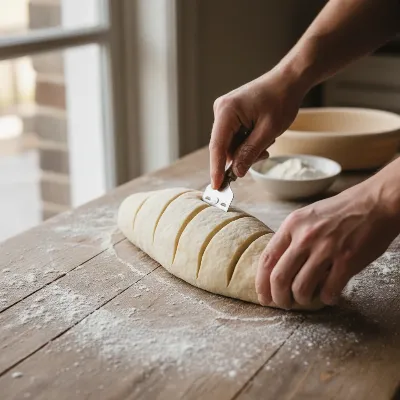 Hands shaping bread dough into baguettes and scoring them before baking.
5. Second Rise (Proofing)
Cover the shaped loaves loosely with greased plastic wrap or a clean tea towel. Let them rise in a warm, draft-free place for about 45-60 minutes, or until almost doubled in size. This final rise, known as proofing, is essential for a light and airy interior.
6. Oven Baking
Preheat your oven to 375-450°F (190-230°C) with a baking sheet or baking stone inside, if using, to ensure even heat transfer. For an extra crispy crust, you can create steam: place an oven-safe pan with 1/2 cup of hot water on the bottom rack when you preheat the oven, or toss a few ice cubes into the hot pan just as you put the bread in.
- Carefully transfer the risen loaves to the preheated oven.
- Bake for 20-30 minutes, or until the crust is golden brown and the bread sounds hollow when tapped on the bottom. For even browning, rotate the baking sheet halfway through.
- If you used an egg wash, you might brush it again halfway through baking for extra shine.
7. Cooling
Once baked, immediately remove the French bread from the oven and transfer it to a wire rack to cool completely. This step is critical; slicing too early can result in a gummy texture inside, as the bread continues to cook as it cools. Patience is key for that perfect interior.
Troubleshooting Common French Bread Issues in Your Bread Maker
Even with the best recipes, baking can present challenges. Here are solutions to common French bread problems:
Dense or Flat Bread
If your French bread turns out dense or doesn’t rise sufficiently, several factors could be at play. The most common culprits are too much flour, too little liquid, or inactive yeast. Always ensure your yeast is fresh and stored correctly. Check water temperature; water that is too hot can kill the yeast, leading to a flat loaf. Inaccurate measurements, especially of flour, can also make the dough too stiff for a proper rise. Ensure you’re scooping flour correctly (stir, then scoop and level).
Pale Crust
A pale crust can be disappointing, especially for French bread. If baking entirely in the bread machine, ensure you’ve selected the “dark” crust setting. Some bread machines simply don’t get hot enough for a truly dark crust. If you’re using the dough cycle and baking in an oven, preheat your oven to a higher temperature (e.g., 400-450°F) and consider adding an egg wash before baking. You can also try increasing the baking time slightly, watching carefully to prevent burning.
Sticky or Wet Dough
French bread dough is generally considered a “high-hydration” dough, meaning it will naturally be a bit stickier than other bread doughs. However, if it’s excessively wet and sloshy, it likely has too much water or not enough flour. Adjust the consistency during the kneading cycle by adding a tablespoon of flour at a time until the dough forms a soft, pliable ball that cleans the sides of the pan.
Collapsed Loaf
A loaf that rises beautifully only to sink in the middle can be disheartening. This often indicates too much yeast, too much water, or too little salt. Salt is vital for strengthening the gluten structure, which supports the rising dough. High altitude can also contribute to this issue, in which case you might need to slightly reduce yeast or liquid.
Tips for Enhancing Your Homemade French Bread
Beyond the basic steps, a few expert tips can elevate your bread maker French bread to artisan quality.
Use a Bread Lame for Perfect Scoring
While a sharp knife works, a bread lame (a razor blade on a handle) offers unparalleled precision for scoring dough. The cleaner the cut, the better the oven spring and the more beautiful the final appearance of your crust.
Create a Steamy Oven Environment
For a truly crisp, crackly crust characteristic of French bread, a steamy environment in the oven is crucial during the initial baking phase. Place a shallow metal pan on the bottom rack of your oven while preheating. Just before you put your bread in, carefully pour about half a cup of hot water into the hot pan (be cautious of steam!). The steam helps to keep the crust soft for longer, allowing the bread to fully expand before it hardens, creating a thinner, crisper crust. Alternatively, toss a few ice cubes into the hot pan when the bread goes in.
> “The secret to an irresistible French bread crust often lies in creating a burst of steam during the first few minutes of baking. It allows the bread to expand fully before the crust sets, leading to that beautiful, airy interior and crackly exterior.” – Chef Antoine Dubois, Culinary Instructor specializing in European Breads
Allow for Complete Cooling
This might be the hardest tip to follow, especially with the intoxicating aroma of fresh bread, but it’s one of the most important. Cooling bread completely on a wire rack allows residual moisture to dissipate and the internal structure to set. Slicing warm bread can release steam too quickly, resulting in a gummy texture. For the best texture and flavor, wait at least an hour, or even two, before slicing.
Conclusion
Baking perfect French bread in your bread maker is a rewarding culinary journey, bridging the convenience of modern appliances with the timeless art of bread making. By understanding the core ingredients, utilizing your machine’s “Dough” cycle for superior shaping, and applying simple oven techniques like scoring and steaming, you can consistently achieve loaves with that coveted crisp crust and tender, open crumb. Don’t shy away from experimentation; each bake is an opportunity to refine your technique and discover your perfect loaf. What will be the first meal you pair with your homemade French bread?
Frequently Asked Questions
What is the ideal water temperature for yeast in French bread?
The ideal water temperature for activating yeast in French bread is typically lukewarm, between 105-115°F (40-46°C), or room temperature (18-20°C). Water that is too hot will kill the yeast, preventing your bread from rising, while cold water will significantly slow down yeast activity, leading to a denser loaf.
Can I use all-purpose flour instead of bread flour for French bread?
Yes, you can use all-purpose flour, but bread flour is highly recommended for French bread. Bread flour has a higher protein content, which is essential for developing strong gluten networks, resulting in the characteristic chewy texture and open crumb that defines authentic French bread. All-purpose flour may yield a less chewy and slightly denser loaf.
Why is my bread machine French bread crust not crispy?
If your bread machine French bread crust isn’t crispy, it might be due to the baking method. Bread baked entirely in the machine often has a softer crust due to the enclosed environment. For a truly crispy crust, use the “Dough” cycle, then shape and bake in a conventional oven, ideally with added steam during the initial baking phase, and an egg wash for browning.
How do I store homemade French bread to keep it fresh?
Homemade French bread is best enjoyed on the day it’s baked. To keep it fresh for a day or two, store it at room temperature in a paper bag to maintain some of its crispness, or in a bread box. Avoid airtight plastic bags, as they can soften the crust. For longer storage, slice and freeze it, then toast individual slices as needed.
Is vital wheat gluten necessary for French bread in a bread maker?
Vital wheat gluten is not strictly necessary for French bread in a bread maker, but it can be a beneficial addition. It helps strengthen the dough’s structure, leading to a firmer texture and a higher, more consistent rise, especially when using all-purpose flour or if your bread flour has lower protein content.
